Surprising claim: an exchange that combines centralized custody, a non-custodial wallet, and a DEX aggregator changes not only convenience but the set of risks an American trader must manage. That’s true of OKX, and the difference matters if you log in from the US, trade spot markets, or move between on‑chain and off‑chain custody. This piece walks through the mechanisms—how OKX stitches a CEX and Web3 tools together—where that design helps and where it creates new decision points for a US-based trader seeking to access OKX and use its spot market efficiently and safely.
We’ll use a single real-world case: a US trader who wants to log into OKX, deposit USD (or stablecoins), buy BTC on spot, and occasionally bridge assets into a self-custodial Web3 wallet to use DeFi. The walkthrough emphasizes the concrete steps, the security and regulatory constraints, and the trade-offs you need to evaluate before clicking “log in.”
How OKX’s hybrid architecture works (mechanism first)
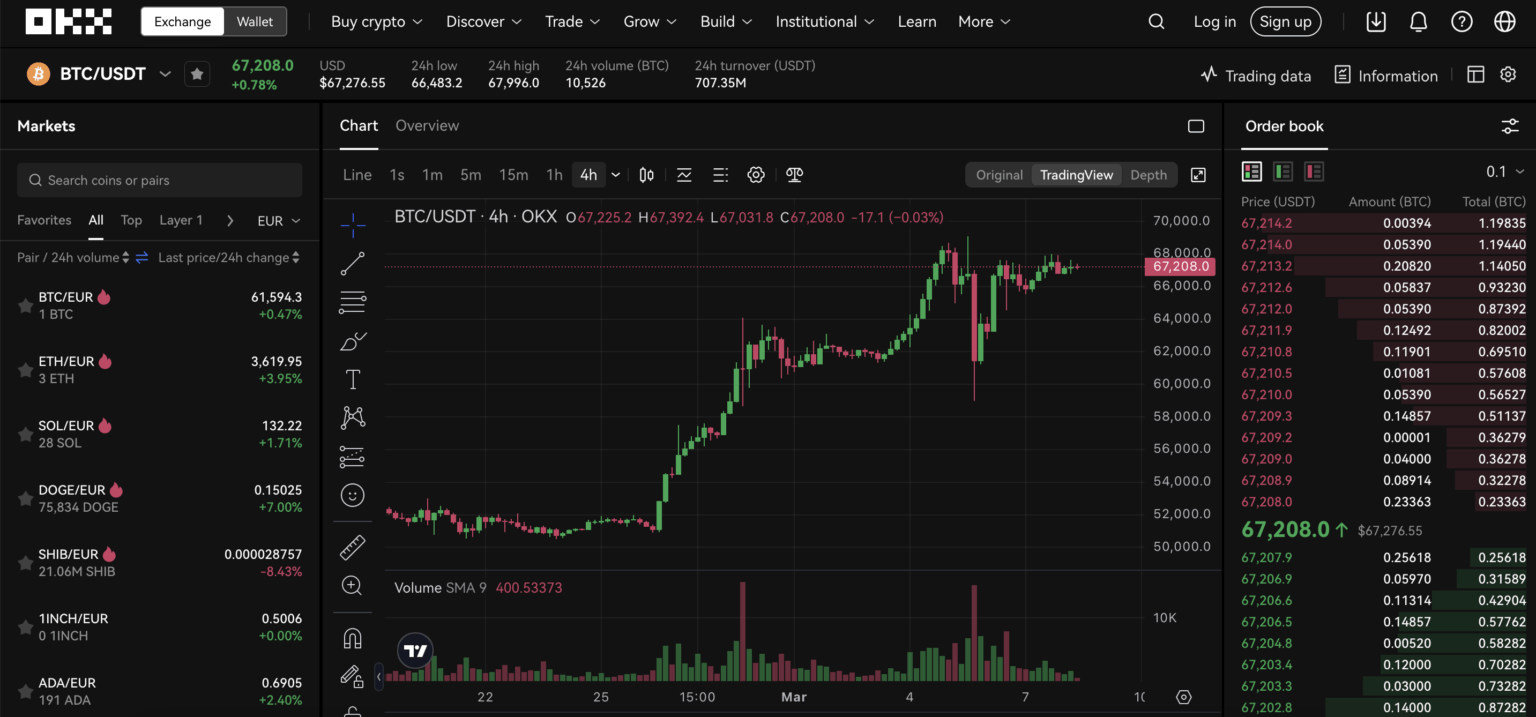
OKX is built as a multi-component platform: a centralized exchange (CEX) with order books and custody, a non-custodial Web3 wallet you control with a seed phrase, and a DEX aggregator that sources liquidity across on‑chain venues. Mechanically, those parts interact in two ways that matter to traders. First, the CEX side provides fast, deep order books, matching engines, and centralized custody—this is where spot trading happens with low latency. Second, the Web3 wallet and DEX aggregator let you perform permissionless swaps and cross‑chain transfers using on‑chain liquidity; the aggregator algorithmically finds routes across automated market makers to minimize slippage and gas costs.
When you “log in” the first time from the US, OKX requires KYC: government ID plus a facial liveness check. That creates a clear separation: accounts on the CEX are tied to identity and the exchange’s custodial security model (including cold storage for ~95% of assets), while the Web3 wallet is non-custodial—if you seed it, OKX does not control your keys. Practically, that means you can move assets from centralized custody to true self-custody, but you also inherit the full risk profile of on‑chain interactions (phishing, lost seed phrases, smart contract risk).
Logging in and preparing to trade: the US-specific checklist
Before you log in, consider four concrete preparatory steps a US trader should take. 1) Verify jurisdictional eligibility: OKX’s product availability can differ by state and over time; ensure your state allows the deposit and trading products you want. 2) Prepare KYC materials: a clear government ID and a quiet space for the liveness check reduce friction. 3) Choose 2FA and biometric options deliberately: OKX supports SMS, TOTP, and biometric logins on mobile—each has trade-offs. SMS is convenient but weaker against SIM swap attacks; authenticator apps are stronger; biometric unlock on mobile is very convenient but should be paired with a secure device. 4) Plan custody flows: decide which assets remain on the exchange for trading and which should move to the non‑custodial wallet or external hardware wallets (OKX supports Ledger/Trezor integration).
If you want to start right now, the platform link to the OKX login and onboarding walkthrough is helpful for direct access: okx. Use it as a procedural companion rather than a trust anchor—always verify URLs and avoid clicking unsolicited links in emails or social feeds.
Spot trading mechanics, slippage and liquidity trade-offs
Spot trading on OKX is straightforward in concept: you place a buy or sell order to match the current market price. The mechanics matter when the market moves quickly or when you’re trading thinly traded tokens. Two mechanisms determine outcomes: the order book depth and the route the DEX aggregator would take for cross-chain swaps.
Depth vs. speed trade-off: market orders guarantee execution but accept the available liquidity at the current price, which can lead to slippage on low‑volume pairs. Limit orders give price control but may not fill. Margin and isolated vs. cross-margin influence how a losing trade affects the rest of your portfolio—isolated margin limits risk to a position, cross-margin shares collateral across positions. For US traders, the platform recently delisted several low-volume spot pairs (RSS3, MemeFi, GHST, RIO, SWEAT), a routine liquidity hygiene step that illustrates one practical implication: if a token has fragile liquidity, the exchange may remove the pair rather than support persistent disorderly markets. That reduces your counterparty risk on the platform, but it also constrains access to niche assets.
Bridging to Web3: when to use the non-custodial wallet and when not to
The Web3 wallet is powerful because it restores self-custody and opens DeFi. Mechanically, moving funds from the CEX to the Web3 wallet involves an on‑chain withdrawal that the exchange signs and processes; once on‑chain, your operations depend on smart contract safety and your own key management. Use cases where the wallet shines: interacting with DApps, staking on‑chain, or holding tokens unsupported by the exchange. Use cases to avoid unless you understand the risks: running complex DeFi strategies without hardware wallet protection, or leaving large sums on a hot Web3 wallet for long periods.
Two critical limitations to state clearly: 1) Proof of Reserves provides transparency about aggregate backing, but it does not eliminate counterparty, regulatory, or operational risk for individual users; it verifies that assets were present on-chain at a point in time. 2) Cold storage secures most assets, but attack surfaces remain—account login fraud, phishing to capture session tokens, and social engineering around recovery are persistent threats.
Decision heuristics: a simple mental model for US traders
Use this three‑step heuristic before each action: Purpose → Exposure → Control. Purpose: Why am I moving funds? Trade, stake, or access DeFi? Exposure: What risks increase if I move funds? Liquidity, slippage, smart-contract risk, regulatory constraints. Control: Which safeguards reduce that exposure? 2FA/authenticator, hardware wallet, withdrawing to cold storage, or using isolated margin for risky spot trades. This framework helps turn abstract risk concepts into operational checklists you can apply on every login and transfer.
What likely breaks and what to watch next
Where the system tends to break: rapid market moves (causing slippage), thin liquidity on niche assets (leading to large spreads or exchange delistings), and human errors transferring seeds or approving malicious transactions on Web3. Near-term signals to monitor include regulatory guidance in the US about custody and stablecoins (which could change how exchanges handle USD rails), changes to the OKX list of supported assets (delistings are routine but meaningful), and upgrades to cross‑chain bridges that affect swap costs and safety. Each of those signals changes the trade-off calculus for keeping assets on-exchange versus moving them on-chain.
FAQ
Do I need KYC to use OKX for spot trading?
Yes. Creating an account for spot trading on OKX requires KYC verification: a government-issued ID and a liveness check. KYC ties your CEX account to an identity, which enables deposit/withdrawal limits, fiat rails, and regulatory compliance—but it also means you cannot remain anonymous on the custodial side.
Is the OKX Web3 wallet safer than leaving assets on the exchange?
“Safer” depends on threat models. The Web3 wallet gives you control over private keys, eliminating custodial counterparty risk. But with that control comes responsibility: lost seed phrases or compromised keys are irreversible. For many traders a hybrid approach—keeping trading capital on the exchange for active spot work and moving longer-term holdings to a hardware‑protected self‑custodial wallet—balances convenience and security.
How does OKX handle security for custodial funds?
Mechanically, OKX stores the majority of user funds in multi-signature, air‑gapped cold wallets, and uses hot wallets for operational liquidity. They also run AI-driven systems to detect suspicious logins and enforce 2FA. Those layers reduce, but do not eliminate, risk—social engineering, insider threats, and novel exploits remain possible.
What is the practical impact of delisted spot pairs like those removed this week?
Delistings remove low-liquidity pairs that can otherwise create disorderly markets. For traders, the impact is simple: if you hold a token on the exchange, check whether the pair is delisted; you may need to withdraw the token to another venue or accept limited liquidity. Delistings are a reminder to avoid assuming perpetual trading availability for every niche asset.
Final practical takeaway: treat OKX as a toolbox with two fundamentally different compartments. The CEX is about speed, liquidity, and identity-linked services; the Web3 side is about control, composability, and on‑chain exposure. Your job as a US trader is to map each intended action to the compartment whose mechanisms best align with your risk tolerance and operational security. If you do that—prepare your KYC, pick a defensive 2FA posture, plan custody flows, and use the three-step Purpose → Exposure → Control heuristic—you’ll convert a single login into a disciplined sequence of choices rather than a single point of failure.